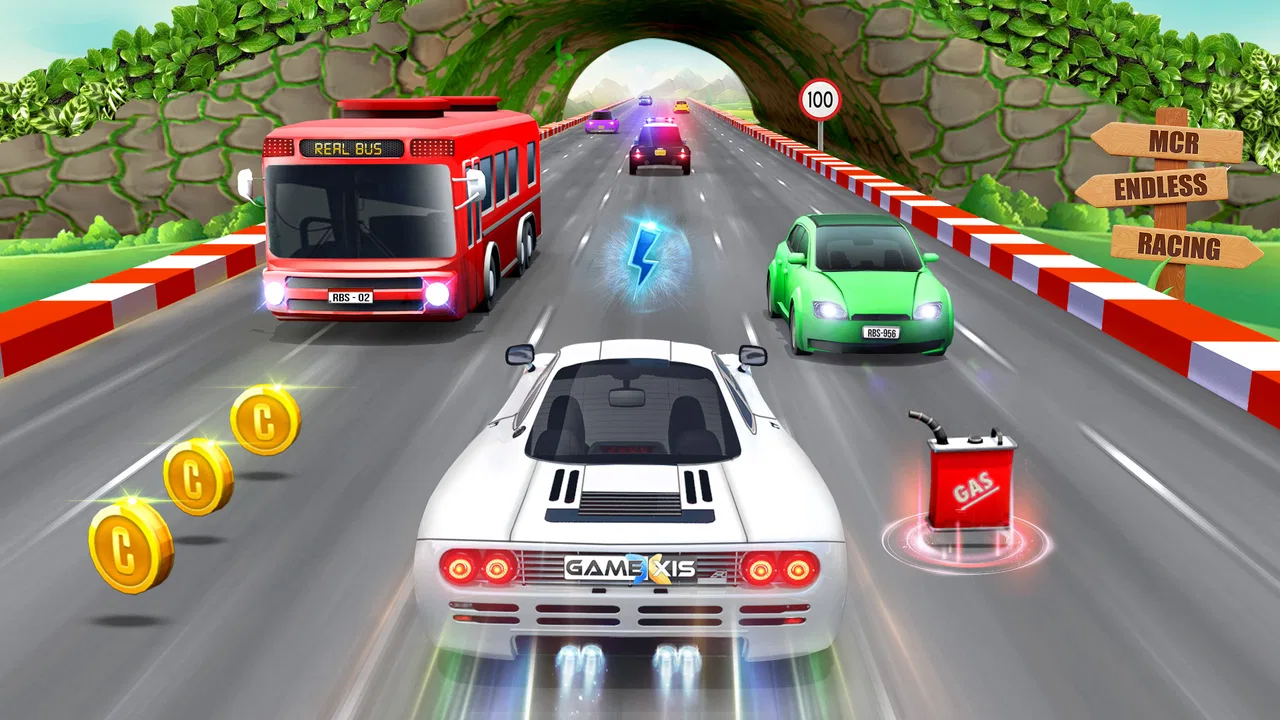
Mini Car Racing Game Legends
- 4.1
- Rating
- 100.00M
- Installs
- Free
- Price

 Analysis by App-foxy
Mini Car Racing Game Legends is the kind of racing game I open when I want quick action rather than a long, serious driving session. Its miniature scale gives the races an immediately playful identity, while the focus stays on fast movement and simple pick-up-and-play excitement. I found it easy to understand within a short session, but it still asks for attention once the pace rises and the track starts demanding cleaner decisions.
Developed by GAMEXIS, this free racing game sits in a comfortable middle ground between a casual time-killer and a more involved arcade racer. It has reached over 100 million installs and holds a 4.1 average from around 143 thousand ratings, so it is clearly not a niche experiment. Those figures matter less than the way it feels in the hand, though: the appeal comes from compact races, a toy-like presentation, and the promise that I can play without committing to a long campaign.
The game is rated Everyone, which makes it a reasonable choice for families or younger players who enjoy racing without mature themes. At the same time, “Everyone” should not be confused with “effortless.” The racing is approachable, but high-speed play still rewards concentration. I would recommend it most to someone who likes colorful miniature vehicles and short bursts of competition, not to someone searching for a realistic driving simulator.
You May Also Like

 AccuWeather: Weather Radar
AccuWeather Review: A Quick, Clear Forecast for Everyday Decisions
For everyday plans, the best forecast is the one you can understand quickly. AccuWeather makes rain timing, radar, and local conditions easy to act on, with a few trade-offs.

 Hill Climb Racing
Why Hill Climb Racing Still Turns Crashes Into One More Run
A tiny car, a bumpy hill and one more upgrade: Hill Climb Racing keeps resurfacing because its simple chaos makes every near-miss feel personal.

 AliExpress - Shopping App
AliExpress Makes Global Shopping Feel Personal, but Shoppers Bear the Risk
AliExpress turns a global marketplace into a pocket-sized discovery engine. Its reach is useful, its shopping loop compelling, and its trade-offs easy to miss.

 Lords Mobile: Kingdom Wars
Lords Mobile Is a Kingdom-Building Routine, Not a Quick Match
A case-by-case verdict on the building, battles, device demands, and social commitments that make Lords Mobile rewarding for some players and exhausting for others.

 PDF Scanner app - TapScanner
TapScanner Makes Paperwork Easier to Capture, Check, and Share
TapScanner makes scanning with a phone feel less like a rescue operation and more like a dependable step in getting work done. Its capture tools are useful, though not flawless.

 Block Blast!
 Shows How Much a Puzzle Game Can Leave Out
A quiet grid game shows why puzzle players increasingly value instant clarity, repeatable skill and low-pressure play—and where the genre still needs to catch up.
More From Our News Desk
View All News


Small cars, clear visual language, and a world built for quick play
The miniature-car concept does more than provide a cute visual hook. It sets the tone for the entire experience. The cars feel like objects designed for playful motion rather than faithful recreations of real vehicles, and that gives the game freedom to prioritize readable turns, quick reactions, and spectacle. I never approached a race expecting authentic suspension behavior or realistic road weight. I approached it expecting the track to be a compact playground.
That distinction is important when deciding whether this is the right download. Players coming from a realistic racing series may find the presentation too light and the driving less demanding in a technical sense. In contrast, anyone who enjoys arcade racing can settle into the idea quickly. The visual scale makes the action feel immediate: a turn is not just part of a highway, but an obstacle in a small, busy environment that needs to be read before the car reaches it.
I also like how the miniature setting supports the game’s mood without requiring a complicated story. There is no need for an elaborate fictional universe to explain why these cars are racing. The appeal is visual and physical. The small vehicles, compact routes, and energetic movement create a toy-box feeling, and that makes the game easier to pick up during an ordinary break.
For me, the strongest use case is a short waiting period. If I have a few minutes before an appointment or want something active between other tasks, this style of racing is more convenient than a large simulation. I can focus on the next stretch of track instead of learning a garage system, tuning a vehicle, or remembering a long sequence of objectives. That simplicity is a strength, although players who want deeper long-term planning may eventually find it limiting.
The art direction also affects how I judge mistakes. In a realistic racer, a missed corner can feel like a serious driving error. Here, the miniature world keeps failure lighter and more inviting. I am more willing to restart and try a different line because the presentation makes experimentation feel like part of the fun. That is especially useful for younger players or anyone who dislikes punishing competitive games.
How the setting shapes the way I play
The compact scale encourages me to look ahead rather than stare only at the car. I pay attention to the shape of the route, the direction of upcoming bends, and the amount of space available for a correction. This is one of the less obvious benefits of the presentation: the toy-like world may look simple, but it makes track reading central to the experience.
My practical advice is to avoid treating every straight section as an invitation to make the biggest possible move. When the car is already moving quickly, a small correction before a bend is usually easier to manage than a dramatic turn at the last moment. The game’s visual style can make the action look carefree, but the best results come from combining that relaxed mood with a little anticipation.
This is also where the game separates itself from endless highway racers. In an endless runner-style alternative, the main challenge is often surviving as the road changes continuously. Here, the miniature racing identity makes each section feel more like a designed course than a simple stream of obstacles. If I want a race-shaped experience instead of a reflex exercise with no clear finish-line feeling, this is the more satisfying direction.
Sound, speed, and the rhythm of a session
The sound design works best when it supports momentum rather than trying to dominate the screen. Racing games depend on rhythm: accelerate, read the route, adjust, recover, and prepare for the next change. The audio helps reinforce that sequence by giving the action a sense of movement, even when I am playing casually.
I would not choose this game primarily for a rich musical soundtrack or a cinematic audio presentation. Its value is in the combined impression of movement and response. The miniature setting looks playful, and the racing pace keeps that playfulness from becoming static. When the action is flowing, the visual and audio sides meet in a coherent mood: light, quick, and energetic.
That rhythm makes the game particularly suitable for short sessions. I do not need to create a long evening around it. A few races can provide a clear burst of activity, and the compact format reduces the pressure to remember a complicated narrative or a large set of systems. This is a useful difference from story-heavy racing games, where stopping after a brief session can feel like interrupting a larger commitment.
There is a trade-off, though. Players who need constant novelty may eventually notice the limits of a focused arcade structure. A playful presentation can make the first sessions feel fresh, but atmosphere alone cannot replace variety forever. I found the experience most enjoyable when I treated it as a repeatable quick-play game rather than expecting it to become my only racing title.
A good everyday routine is to play with a specific purpose. I might use one session to practice cleaner cornering, another to relax without chasing a perfect result, and another to see whether I can improve a previous performance. That small change in mindset keeps the game from turning into aimless repetition. It also makes the pacing feel more deliberate: each short visit has a reason, even if the reason is simply to unwind.
Where the mechanics fit the miniature mood
The main mechanical appeal is accessibility. The game is built around the immediate pleasure of controlling a small car at speed, not around the complexity of a full motorsport package. I can understand the basic goal quickly, which makes it a good entry point for someone who rarely plays racing games on a phone.
That accessibility does not mean I can play without looking ahead. Speed compresses decision time, and the difference between a controlled approach and a late reaction becomes more noticeable as I improve. My most useful adjustment was to stop making constant corrections. Short, purposeful inputs helped me maintain a cleaner line than repeatedly steering back and forth.
This is a concrete advantage for touchscreen play. On a phone, excessive input can make a car feel nervous, especially when the action is already moving quickly. I get better results by treating steering as a series of small decisions: identify the next change, make the correction, then return attention to what follows. That approach also fits the game’s visual language, because the compact courses reward planning without demanding simulation-level precision.
Compared with a kart racer, Mini Car Racing Game Legends feels less dependent on character personality or item-based chaos. A kart-focused alternative may be better if I want dramatic power-ups, recognizable racers, or a more theatrical competitive atmosphere. This game is a better match when the attraction is the car itself, the speed of the route, and the satisfaction of keeping control through a busy section.
Compared with a realistic racing simulator, the trade-off is even clearer. A simulator offers more authentic handling, vehicle behavior, and driving discipline, but it also demands more time and patience. This game gives me faster access to the fun. I would choose it for a casual commute break or a quick home session, while I would choose a simulator when I specifically wanted to study braking, racing lines, or vehicle setup.
The free entry point helps with that decision. I can try the core experience without paying upfront, which lowers the risk for a curious player. The game includes in-app purchases ranging from $3.49 to $29.99 per item, so anyone trying to keep spending under control should approach optional purchases carefully. I personally recommend playing long enough to decide whether the basic racing loop is enjoyable before considering any purchase. If the driving itself is not appealing, extra spending will not solve that problem.
The current version is 6.0.39, and the game requires Android 7.0 or later. That makes checking the phone’s operating system a sensible step before installing. The technical requirement is not the most demanding part of the decision, but compatibility still matters, especially on an older device. I would also avoid judging the game from its miniature look alone; simple art does not automatically mean that every older phone will feel equally comfortable during fast action.
Who will enjoy it, and who should choose something else
I think this is a strong fit for players who want a free arcade racer with a clear visual identity, quick sessions, and an Everyone age rating. It is also a sensible first racing game for someone who finds realistic titles intimidating. The miniature cars make the experience friendly, while the speed gives it enough energy to avoid feeling like a passive toy.
Families may appreciate the accessible tone, but I would still encourage younger players to understand the purchase options before playing independently. The game is free to start, yet the presence of paid items means household rules about spending are worth setting in advance. That is not a reason to avoid the game; it is simply part of using any free-to-play title responsibly.
I would skip it if my priority were realistic physics, a deep vehicle collection, a story campaign, or a serious online racing community. I would also look elsewhere if I needed a game that remains equally engaging during long uninterrupted sessions. The focused arcade design is at its best in short or medium bursts, and forcing it to serve as a full simulation substitute would create the wrong expectations.
One useful way to test the fit is to ask what I want from the next ten minutes. If I want immediate movement and a light atmosphere, this game makes sense. If I want to customize a car, follow a detailed career, or compare technical driving choices, another racing category will probably suit me better. That simple question prevents the most common disappointment: expecting miniature arcade racing to behave like a console-style motorsport game.
My final view of the atmosphere and the drive
What stays with me is the consistency between the game’s look and its pace. The small-car setting promises playful action, and the racing loop delivers that through quick movement and readable challenges. The sound and visual presentation work together to keep the mood energetic without making the game feel overly serious.
Its limitations are equally clear. The accessible approach may not satisfy experienced racers who want detailed simulation, and the free-to-play structure requires awareness around optional purchases. The compact format can also lose some impact if I expect endless depth from every session. Those are real compromises, but they are easier to accept when I use the game for what it does best.
After spending time with it, I see Mini Car Racing Game Legends as a practical recommendation for casual racing fans, younger players, and anyone who enjoys a toy-like world with a quick pulse. GAMEXIS has shaped the experience around immediate fun rather than realism, and that choice gives the game its strongest identity. The large install base and 4.1 average suggest broad appeal, but my recommendation is more specific: try it if you want a compact arcade racer that can brighten a short break.
My bottom line: this is a free racing game worth trying when miniature cars, energetic pacing, and straightforward phone-friendly action sound more appealing than technical depth. I would keep it as a quick-play option, not as a replacement for a full simulator or a content-heavy kart racer. For the right player, that focused role is exactly why it works.
FAQs for Mini Car Racing Game Legends
01What devices are compatible with Mini Car Racing Game Legends?
Mini Car Racing Game Legends is designed to be compatible with both Android and iOS platforms. For Android users, it typically requires Android 5.0 or later, while iOS users need iOS 10.0 or later. Ensure your device meets these requirements for optimal performance and gameplay experience.
02Is Mini Car Racing Game Legends free to play?
Yes, Mini Car Racing Game Legends is free to download and play. However, it includes in-app purchases for players who wish to enhance their gaming experience. These purchases may include special cars, upgrades, or customizations. Players can enjoy the game without spending money, but purchases can provide advantages.
03What game modes are available in Mini Car Racing Game Legends?
The game offers multiple modes, including Championship, Time Trial, and Multiplayer. Championship mode allows players to compete in various tournaments, Time Trial challenges them to beat their best times, and Multiplayer lets them race against friends or other players online. Each mode offers a unique experience and challenges.
04How does the multiplayer feature work in Mini Car Racing Game Legends?
The multiplayer feature enables players to compete against friends or other global players in real-time races. Players can join existing races or create their own. A stable internet connection is required for seamless multiplayer gameplay. This feature adds a competitive edge and enhances the social aspect of the game.
05Are there any customization options for cars in the game?
Yes, Mini Car Racing Game Legends offers extensive customization options. Players can personalize their cars with a variety of paint colors, decals, and performance upgrades. These customizations allow players to express their style and improve car performance, making the game more engaging and tailored to individual preferences.
Pros
- Intuitive controls for easy gameplay.
- Vibrant graphics enhance the racing experience.
- Multiple tracks keep the game engaging.
- Customizable cars add a personal touch.
- Quick loading times for instant action.
Cons
- Limited car options in free version.
- Some ads can be intrusive during play.
- Occasional lag on older devices.
- In-app purchases can be pricey.
- No offline mode available.

Mini Car Racing Game Legends
Gallery